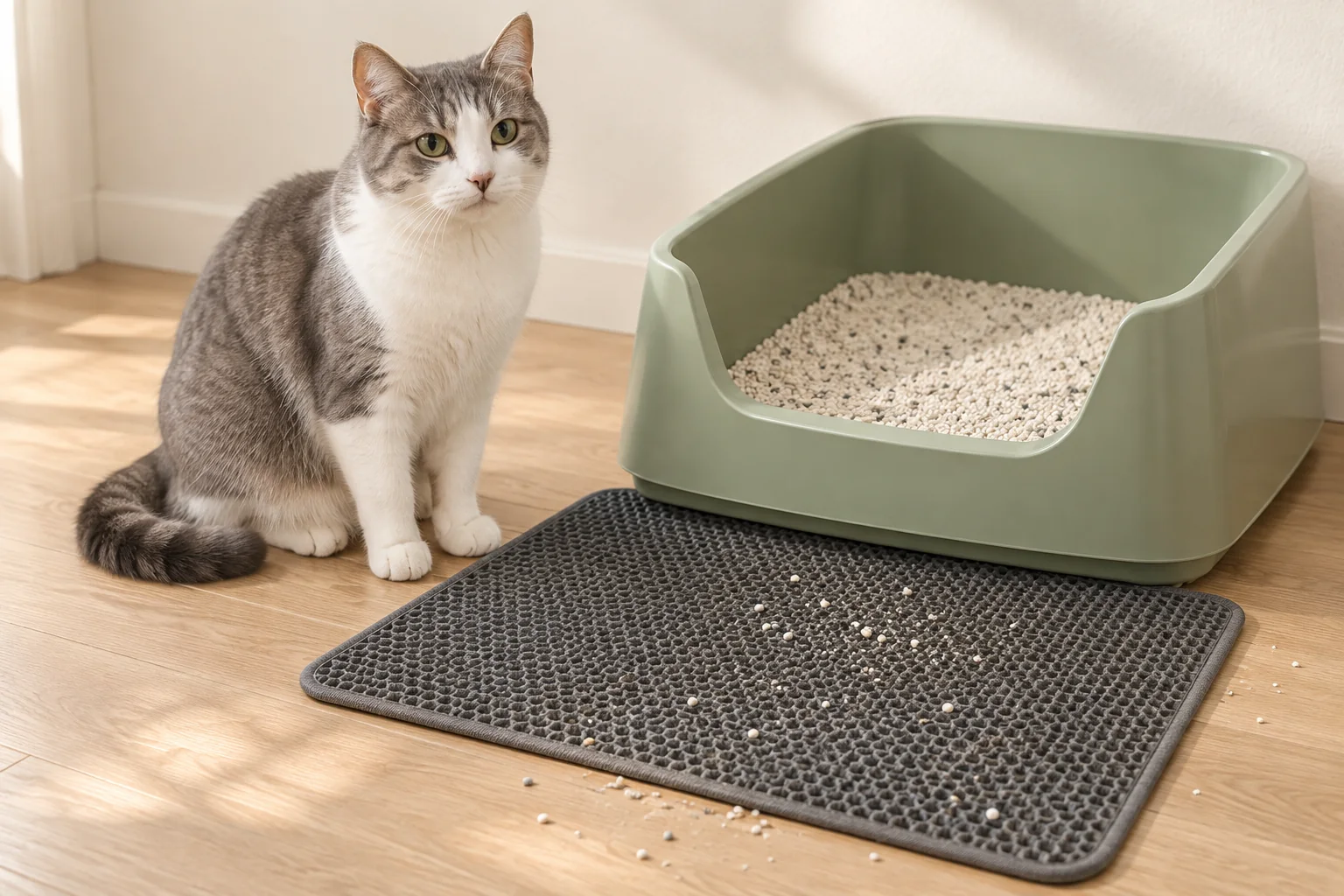
You have swept around the litter box, but soon you are stepping on litter in the living room again. To reduce cat litter tracking, start by checking whether litter is being carried out on your cat’s paws or kicked over the sides of the box. Knowing how it reaches the floor makes it easier to decide whether to adjust the mat first or check the litter box itself.
A mat may help collect loose litter, but your cat also needs to feel comfortable using the box. Do not block the entrance or remove all the familiar litter at once just to keep the floor clean. Our guiding principle is to reduce scattered litter while keeping the litter box comfortable to use. [1] [2]
Three key takeaways
01
Find out how litter escapes
Distinguish litter carried on paws from litter kicked out during digging.
02
Check the mat and entrance
Consider where your cat steps, whether the mat slips, and how easily it cleans—not just its size.
03
Keep the box comfortable
Even if less litter escapes, rethink the setup if your cat starts avoiding the box.
Cat litter tracking and scatter are different from airborne dust
Litter can end up on the floor outside the box in two ways. Granules caught on paws or fur may fall off as your cat leaves—often called litter tracking—or litter may be kicked over the sides during digging and covering. Both can happen in the same home.
Airborne dust is a separate issue: fine particles rise into the air when litter is poured or disturbed by digging. A mat that catches litter on the floor does not also solve airborne dust. When reading product descriptions, do not assume that “low dust” and “low tracking” mean the same thing.
This article focuses on reducing litter granules on the floor. If odor or soiling is your main concern, see our guide to how often to change cat litter and clean the litter box.
Start by checking where the litter ends up
Before cleaning, look at whether litter has collected in front of the entrance or spread beyond the sides. When your cat uses the box, observe their usual movements from a distance. Avoid hovering nearby or getting in the way.
| What you notice | What to check first |
|---|---|
| A trail of litter leads away from the entrance | Check whether the mat covers the spot where your cat first steps out, and whether they jump over it or walk around it. |
| Litter piles up beside or behind the box | Watch which way litter flies during digging, and check that your cat has enough room to turn around inside. |
| Litter keeps spreading despite a mat | Check whether the mat has shifted, collected litter is being stepped on again, or litter is being kicked directly beyond the mat. |
This table suggests an order for checking your setup at home. The location of loose litter alone cannot establish the cause or predict how well a particular product will work.
Choosing a litter mat: look beyond the material
Best Friends Animal Society’s caregiver guidance includes placing a mat or small rug around the litter box. That does not mean one material or a honeycomb design is best for every cat. [1]
Check four things before buying
- Available space: Measure whether the mat can cover both the entrance and the area where your cat steps after leaving. Cats enter and leave from different directions in different homes, so there is no single right size.
- Feel underfoot: Check for rough raised surfaces or places where claws might catch. If your cat avoids the mat, its litter-catching design alone does not make it a good choice.
- Stability on the floor: Check whether the mat slides when stepped on or its edges curl up. If you overlap two mats, look for edges that could catch a paw.
- Cleaning: For a double-layer mat, check whether litter is easy to empty from inside. For grooved designs, check whether you can clean the crevices. For fabric mats, consider whether you can dry them thoroughly after washing.
Alongside price and material, compare whether your cat actually walks over the mat and how easy it is to maintain.
Place it on the exit route without forcing a path
Try placing the mat where your cat naturally steps after leaving the box. A mat placed only at the front may miss a cat who exits to the side. After adjusting its position, also check whether your cat’s behavior when entering the box has changed.
Do not narrow the entrance with furniture or panels to make your cat step on the mat. Your cat needs to be able to leave the box without another cat blocking the way. For the overall setup, see our guide to where to place a cat litter box. [2]
Empty collected litter and check underneath
When tidying the litter box, check the top, inside, and underside of the mat too. Empty the loose litter, then follow the product’s cleaning instructions if the mat is soiled. After washing, rinse and dry it thoroughly before putting it back. Whether a mat can be rinsed with water or machine-washed depends on the product. [5]
Do not pour litter back into the box if it contains urine, feces, cleaning products, or other contamination. Discarding litter collected from the floor when you cannot tell whether it is contaminated is also a cautious approach to hygiene. Cleaning the mat does not replace scooping waste or fully changing the litter in the box.
Are taller litter boxes always better for containing litter?
If plenty of litter is kicked over the sides, you can consider the wall height. First, though, check that your cat has enough room inside to turn, dig, and cover waste. Easy, comfortable entry and exit come before keeping litter contained. Older cats and cats with limited mobility may especially need a low entrance. [2]
A covered box may help reduce litter being kicked out, but some cats dislike trapped odors or a restricted view of their surroundings. Rather than automatically removing a familiar open box and replacing it with a covered one, judge the choice by whether your cat actually uses it. [3]
Will switching bentonite or tofu litter solve the problem?
The material name alone does not justify claims that tofu litter never tracks or all bentonite clay litter scatters badly. Consider the product’s granules, how it crumbles during use, how your cat digs, and the route they take out of the box. Another household’s review does not mean your cat will respond in the same way.
Your cat’s preferences matter as well as ease of cleaning. Many cats prefer fine litter that feels soft under their paws, and strong fragrances may discourage litter box use. For that reason, switching to coarse granules or a strongly scented product simply because you are worried about tracking is not recommended. [4]
Using less litter is not always the answer
Do not spread litter in a very thin layer just to reduce the amount reaching the floor. Check that your cat can dig and cover waste, and follow the product’s directions. Equally, adding more litter does not mean you can clean less often. [1]
If you need a change, keep a familiar option
If your cat uses the current litter comfortably, start by checking the mat and the surrounding area. Frequent litter changes can lead to litter box avoidance. If you need to compare a new product, consider keeping the existing box unchanged and offering the other litter in an additional box, then observing which one your cat uses. Changing other conditions at the same time makes it harder to tell what your cat is responding to. [3]
Your checklist for reducing cat litter tracking
Before buying several products at once, work through the checks below. Adjust one item where you find a problem. At the next cleaning, compare where litter remains and how your cat uses the box to get a clearer picture of what has changed.
- Observe: Have you noted where litter collects—at the entrance, beside the box, or along your cat’s path?
- Mat: Is it where your cat naturally steps, with no slipping or folded edges?
- Cleaning: Have you checked for accumulated litter and soiling inside and underneath the mat?
- Box: Does your cat have room to turn around and an entrance they can use comfortably?
- Litter: Have you considered the product’s directions and your cat’s preferences, while keeping a familiar option?
- Response: Is your cat still using the box as usual after the adjustment?
Cat litter tracking: frequently asked questions
Q. Will buying a litter mat solve the problem?
First, check whether your cat actually steps where the mat sits. If litter is being kicked straight over the side of the box, a mat in front of the entrance alone may struggle to catch it. Check both how the litter escapes and where the mat is placed.
Q. Does tofu litter always scatter less than bentonite litter?
You cannot conclude that from the material name alone. Individual products differ in form, and cats differ in how they use them. Keep litter that your cat uses comfortably while adjusting the surroundings first. If a change is needed, compare your cat’s response to using it.
Q. Should I stop my cat from jumping over the mat?
Recheck the mat’s position, feel, and stability rather than putting up barriers. Reducing scattered litter should not make the box difficult to enter or leave. [2]
Q. Can I pour litter collected in the mat back into the box?
Collected litter is not necessarily as clean as fresh litter. If it is contaminated with urine, feces, or other substances, or you cannot tell whether it is clean, choosing not to reuse it is the cautious approach. Even if the product includes instructions for recovering litter, check for actual contamination first.
Q. Does the mat need washing with water every day?
Emptying loose litter and washing with water are separate tasks. Clean according to how soiled the mat is and the product’s instructions, and let it dry thoroughly after washing. One washing schedule does not suit every material. [5]
Reducing cat litter tracking does not start with buying the most expensive mat or box. Look at where litter scatters, check the mat and entrance, and make sure your cat is comfortable using the box. Today, you can start by noting where litter has collected before cleaning and checking the position of the mat you already have.
References
- Best Friends Animal Society: Kitten Foster Manual
Guidance on mats and litter depth in the litter box appendix. This is not a comparison of individual mats’ performance. - Cat Friendly Homes: Everything You Should Know About Litter Boxes
Space inside the box, entry and exit routes, and your cat’s comfort. - Humane World for Animals: How to Litter Train a Kitten or Cat
Benefits and drawbacks of covered boxes, and caution about frequent litter changes. - Cats Protection: Cats & Toileting
Choosing a box for the individual cat, low entrances, and preferences for litter texture and scent. - CDC: About Cleaning and Disinfecting Pet Supplies
Following cleaning instructions for individual pet supplies, including rinsing and drying. - Cornell Feline Health Center: Feline Lower Urinary Tract Disease
Urinary problems and emergency signs when little or no urine is passed.
Sources checked:
This article provides general information to help with everyday cat care. The checklist and pre-purchase checks apply principles from the sources above to the home environment. This article does not report hands-on tests of specific products and has not been reviewed by a veterinarian. If you notice unusual changes in your cat’s toileting behavior, consult your veterinarian.