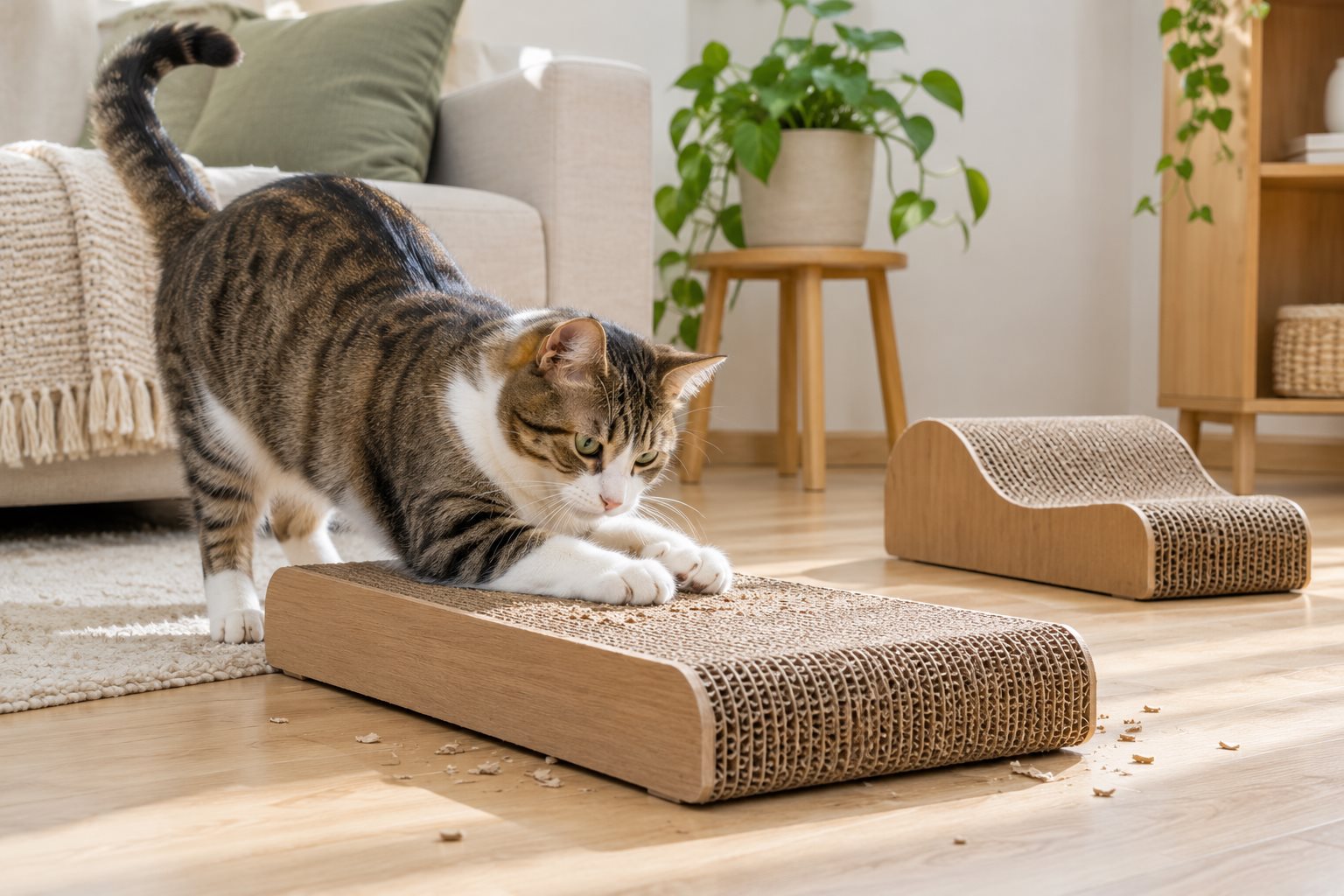
The best cat scratcher is one that suits your cat’s scratching posture, stays stable and sits where your cat wants to use it. Price alone is not a reliable guide, and a large cat tree does not necessarily replace a well-chosen scratching surface.
Why cats need a scratching surface
Scratching is normal feline behavior. It helps shed the outer layers of claws, allows cats to stretch and leaves both visible marks and scent signals from the paws. The goal is not to stop scratching altogether, but to provide an appealing place for it.
Trimming claws does not remove the urge to scratch. Claw care and access to scratching surfaces meet different needs.
Four things to check before buying
1. Match your cat’s preferred position
- Scratches sofa sides or posts: try a vertical scratcher.
- Scratches rugs or floors: offer a horizontal pad.
- Seeks sloping surfaces: an angled scratcher may appeal.
These habits are clues, not guarantees. If you are unsure, offer a small selection of different orientations or textures and watch what your cat chooses.
2. Prioritize usable space and stability
A vertical post should let your cat reach up and stretch fully while scratching. A horizontal scratcher needs enough surface area for your cat to brace comfortably. Choose according to your cat’s body size rather than a universal measurement.
Wobbling or sliding can discourage use. Check the base, floor grip and assembly joints. Install wall-mounted products according to the manufacturer’s instructions.
3. Let your cat decide on texture
| Material | What to expect | What to monitor |
|---|---|---|
| Cardboard | Available in many shapes, often with replaceable scratching sections | Debris, collapsed areas and chewing or swallowing pieces |
| Sisal rope or fabric | Common on posts and provides a different texture from cardboard | Loose strands, unraveling rope and exposed fasteners |
| Carpet | An option for cats that prefer a textile surface | Loops or frayed areas that catch claws |
No material is best for every cat, and durability varies with construction and use.
4. Consider age and mobility
Kittens need stable, accessible options. Older cats or cats with joint discomfort may find a low horizontal pad or gentle incline easier to use. A change in mobility deserves attention rather than simply a different product.
Where to put a cat scratcher
Start near a favorite sleeping spot, along a frequently used route or beside furniture your cat already scratches. A hidden corner may be convenient for you but unappealing to your cat.
To protect furniture, place the scratcher close to the targeted surface and consider a securely fitted furniture cover. Once your cat uses the scratcher reliably, move it gradually if necessary. In multicat homes, provide scratching opportunities in separate locations so one cat cannot easily block access to all of them.
Keep narrow walkways and litter box entrances clear. If you are reorganizing your cat’s space, see the cat litter box location guide as well.
What if your cat ignores it?
- Check for wobbling, slipping or an undersized surface.
- Move it beside a place your cat already scratches.
- Change one feature at a time, such as orientation or texture.
- Reward voluntary scratching promptly with a treat or play.
Do not hold your cat’s paws against the scratcher or punish scratching with shouting or water sprays. A small amount of catnip may attract cats that respond to it, but not all cats do. Avoid applying essential oils to encourage use.
When should you replace it?
There is no replacement schedule that fits every scratcher. Repair or replace it when the surface collapses, the structure becomes unstable, rope unravels into long strands or sharp hardware becomes exposed. Ordinary wear alone does not mean it must be discarded immediately.
If your cat swallows pieces, stop access and contact your veterinarian. For a cat wary of new objects, briefly placing the replacement beside the old scratcher may help—but only if the old one remains safe.
Know when to contact a veterinarian
Suddenly avoiding scratching, reacting painfully to paw handling, limping or bleeding from a broken claw should not be dismissed as a preference issue. Contact your veterinarian. For further veterinary-based information about feline behavior and home care, visit Cat Friendly Homes.
Choose a stable surface, match your cat’s preferred posture and put it somewhere useful. Then adjust based on actual use rather than appearance or marketing claims.