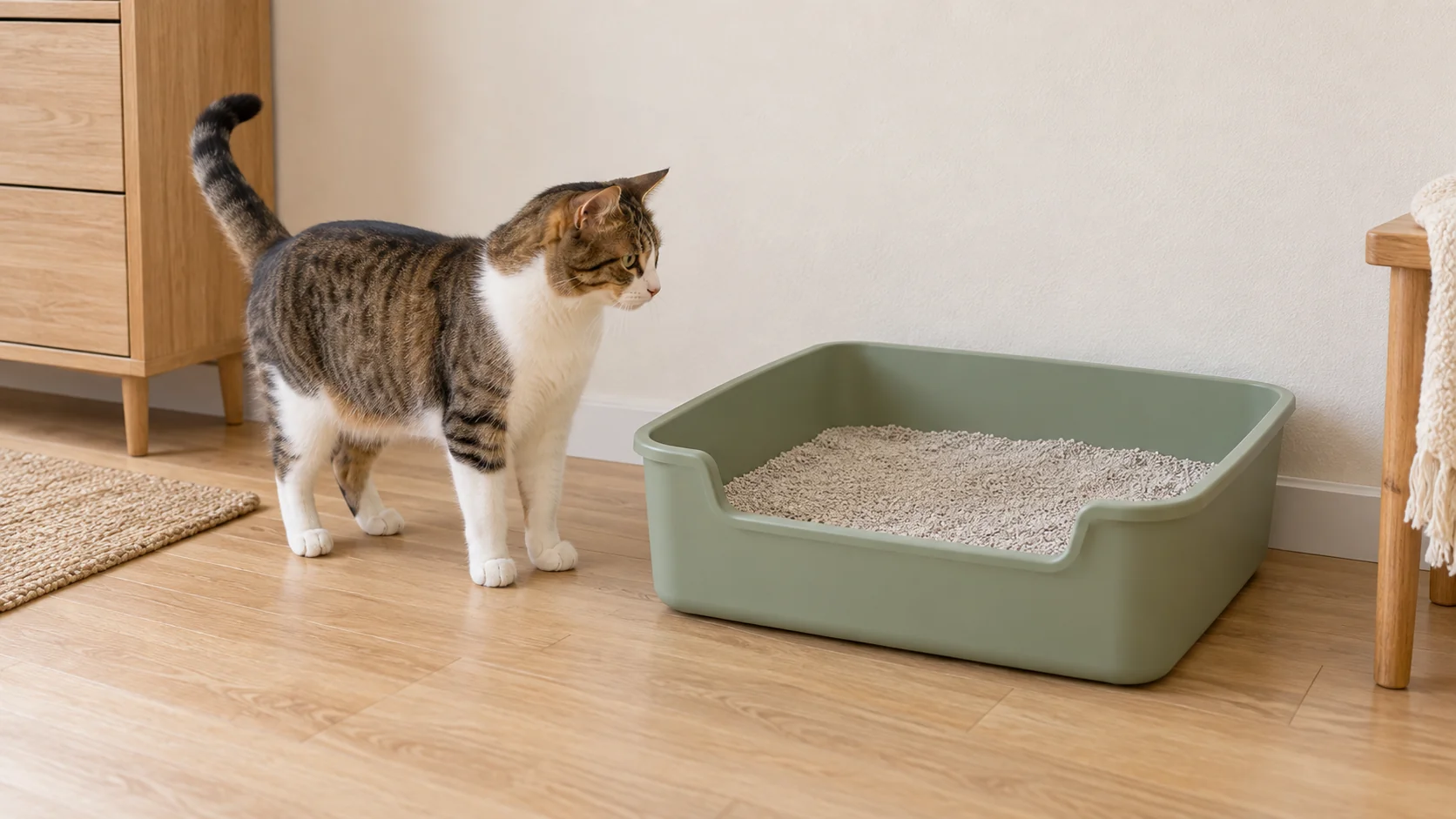
The living room puts the litter box on display, the bathroom door is often closed, and the balcony may get too cold. Sound familiar? In a studio apartment, keeping the box away from beds and food bowls can feel especially tricky. The best place for a litter box is less about the name of the room and more about whether your cat can use it comfortably whenever they need to.
This guide will help you compare locations, plan for more than one cat and move a box when necessary. One important exception comes first: if your cat keeps straining but passes little or no urine, contact a veterinarian immediately and seek urgent care. Do not wait to see whether moving the box helps. [7]
Three key takeaways
01
Keep access open
A spot your cat can reach at night and while you are out matters more than hiding the box.
02
Choose quiet and separation
Limit noise and interruptions, and keep the box separate from food, water and resting areas.
03
Let use guide a move
Do not rush to remove a familiar option. Check that your cat is actually using the new location.
Where to put a litter box: four essentials
A good location is easy to reach and lets your cat toilet without interruption. Before asking whether a box fits into an empty space, think about what your cat would experience there.
- Access stays available, day and night. Check whether the door is closed when someone uses the bathroom or goes to bed. A room your cat can only enter with your help is a poor choice for their only litter box. [1]
- There is little sudden noise or passing traffic. A laundry area or entrance hall may seem quiet now but become busy or noisy at particular times. [1]
- Eating, drinking, resting and toileting areas are separate. Grouping all your cat’s supplies together may be convenient for you, but avoid putting food bowls right beside the litter box. [2]
- Your cat can get in and out without being blocked. Even a quiet corner needs a second look if furniture or another cat could leave your cat feeling trapped. Privacy should not mean having no way to get away. [3]
For kittens and older cats, check the route too
The same location may become harder to use as a cat’s needs change. Check that a kitten can comfortably step into the box. For an older cat or one with sore joints, provide access on the floor where they spend their time, with a low entrance and a route that is not slippery. Reluctance to cross a threshold or climb stairs should not simply be dismissed as stubbornness. [2] [6]
Living room, bathroom or enclosed balcony?
The comparisons below are examples of applying the placement principles, not results from a home trial or a ranking that works for every property. Door habits and appliance locations can make two otherwise similar apartments very different.
| Location | Conditions to consider |
|---|---|
| Living room | Worth considering: A spot away from the main walkway with clear access. Avoid: Right beside a TV or speaker, or anywhere children or other animals keep approaching. |
| Bathroom | Worth considering: A dry area away from the shower that your cat can always reach. Avoid: A room regularly shut during showers or ventilation, or a spot beside a washing machine. |
| Enclosed balcony | Check first: Whether this is a secure indoor-like space with reliable access and comfortable conditions in both hot and cold weather. Choose another indoor spot if: The door is closed at night or in winter, or your cat could escape or fall through an opening. |
| Studio apartment | Worth considering: A layout that creates separate eating, resting and toileting areas. Avoid: Squeezing the box between a bed and food bowls, or using furniture to block its entrance. |
Good ventilation alone does not make a balcony suitable
Here, an enclosed balcony means a fully enclosed, indoor-like space separated from the outdoors by windows or similar structures. It does not mean an open-air balcony. Open windows and balconies pose a fall risk, and cats may escape through gaps. An ordinary insect screen is not proof that a space is secure. [4]
Ask whether your cat can still get there when it is very hot or cold, not just whether you leave the door open during the day. If using the box depends on someone opening a door or crossing an unsafe area, consider a different indoor location rather than choosing the balcony simply because you notice less odor. This is an application of the access and safety principles, not a guarantee about any particular space.
Finding a litter box spot in a small apartment
In a small home, mapping daily routines can be more useful than buying a new product first. A studio does not have to put food bowls and the litter box in one row. Even without separate rooms, look for ways to create distinct areas.
- Sketch a simple floor plan. Mark beds, food and water bowls, doors, appliances and the paths people regularly use. It does not need to be to scale.
- Note the difficult times for two possible spots. Think about showers, laundry, sleep and time away from home. This can reveal problems that an empty floor space does not show.
- Check the route with the box in place. A box fitting into a gap does not help if your cat cannot turn or leave comfortably. Keep access open even if you use a room divider for privacy.
- Compare with the location your cat already uses. If it is working well, there is no need to move it quickly just because another arrangement looks tidier in a photo. Identify an actual problem first.
There is no single distance in feet or meters prescribed by this guide. A number alone could suggest that placement is fine even when access or separation is poor. Avoid putting the box immediately beside food bowls, and look for the separation and quiet routes your home can realistically provide.
Multi-cat homes: count the boxes and separate the locations
A useful starting point is one litter box per cat, plus one extra. Plan for two boxes for one cat, or three for two cats. Meeting that number does not guarantee that every toileting problem will disappear. [3]
Three boxes lined up together may be easy to clean, but they offer little choice if access to that whole spot is blocked. Put boxes in different places and check whether a timid cat must pass another cat to reach one. Genuinely separate access routes matter more than leaving a small gap between boxes. [3]
In a home with more than one floor, plan for a box on each level. If a cat with mobility difficulties must use stairs every time they need the box, improve access on the level where they spend their time. [6]
If space is tight, reconsider furniture and unused areas rather than clustering undersized boxes together just to reach the total. Noting which boxes each cat actually uses can help you identify where another option might be needed.
How to move a litter box
A furniture change or a move may mean the box needs a new home too. Choosing the new spot and helping your cat accept it are separate tasks. Avoid shifting the box several times a day just because a location seems imperfect.
For a small change in position
Cornell describes moving a box gradually once a cat uses it reliably, and returning it to the last reliably used spot if use stops. Adjust the pace to your cat’s response rather than setting the same completion date for every cat. [5]
For a bigger move, such as another room
Where practical, consider adding a box in the new location and checking whether it is used. This preserves a familiar option instead of removing the old one immediately. In a multi-cat home, keep checking the number and distribution of boxes throughout the transition. [3]
Keeping the litter and box type unchanged during the move can make your observations easier to interpret. That is a way to compare responses, not a promise of successful adjustment. If your cat is not using the box, do not push ahead without checking for pain or other problems.
Difficulty passing urine is not something to watch and wait on as your cat ‘gets used to the new spot.’ Check the veterinary warning signs below first. [7]
Your litter box placement checklist
Use these questions to compare the current location with a possible new one. This is a home-layout checklist, not a diagnostic score that can rule out a problem.
- Can your cat reach the box independently at night, during showers and while you are out?
- Are interruptions limited even when appliances are running or people are moving around?
- Are food bowls, water bowls and resting areas kept away from the box?
- Can your cat enter and leave without furniture or another animal blocking the route?
- Have you checked windows, fall risks, uncomfortable temperatures, slippery floors and high thresholds?
- Is the box easy to clean, and can you tell whether each cat is using it normally?
If a question is hard to answer, see whether changing a door habit or moving nearby items could help before buying something new. Address the clearest difficulty first, then observe the response rather than changing everything at once.
When veterinary care comes before changing the layout
Toileting outside the box does not prove that its location is wrong. Problems with the box or litter, relationships with other animals, illness or difficulty moving may all play a part. If toileting habits change suddenly, contact your veterinarian to help identify the cause. [5]
Blood in the urine, crying or pain while urinating, and unusually frequent urination also warrant prompt veterinary advice. Rather than trying to diagnose the cause from appearance alone, explain what changed and when it started. [7]
Litter box placement: frequently asked questions
Can the litter box go beside my bed in a studio?
Being near a bed does not automatically rule a spot out. First, look at whether furniture can be arranged to separate your cat’s eating and resting areas from the box. Do not achieve that separation by squeezing the box into a tight space your cat cannot easily enter or leave.
How far should it be from the food bowl?
This guide does not set a minimum distance for every home. Apply the principle of keeping the box out of the immediate feeding area to your layout. Even a seemingly generous distance is not enough if the route is noisy or blocked.
Would moving it to the balcony help with odor?
Start by checking waste removal and how clean the box itself is. Moving a dirty box farther away does not solve the discomfort for your cat. Avoid trying to cover odors with strongly scented litter, and assess balcony access, temperature and window safety separately. [2]
Are two boxes side by side enough?
There are more boxes, but not necessarily independent choices. If another cat blocks the area, both may be hard to reach. Where possible, separate the locations so your cat can use one when the other feels uncomfortable.
How many days does adjustment take?
There is no guaranteed timeline for every cat. Watch actual use rather than the calendar. If use stops, return to the last reliably used location and investigate why. This observation process is not a reason to delay veterinary care for trouble urinating. [5]
Should I punish accidents after moving the box?
No. Work out why your cat is toileting outside the box. Cats Protection advises against punishment and recommends checking for medical causes when behavior changes suddenly. Clean the affected area and review the layout while arranging any needed veterinary care. [2]
The best litter box location is not necessarily the one that hides it most neatly. It is somewhere your cat can use comfortably whenever needed. Check reliable access, quiet and separation, and normal use after any move. Those are three practical places to start today.
References
- Cats Protection: How to create a cat-friendly home
A quiet location your cat can always reach, away from disruptive appliances and busy routes. - Cats Protection: Cats & Toileting
Separation from eating and resting areas, litter box hygiene, sudden changes in toileting and avoiding punishment. - Cat Friendly Homes: Everything You Should Know About Litter Boxes
The cats-plus-one guideline, separate locations and clear access routes. Caregiver guidance from FelineVMA. - Cats Protection: Our Guide to Indoor Cats
Fall risks around open windows and balconies. This does not establish whether a particular enclosed space is suitable. - Cornell Feline Health Center: Feline Behavior Problems — House Soiling
Possible causes of house-soiling and the principle of moving a box gradually, returning it if use stops. - Cat Friendly Homes: Home Modifications for Your Cat
Accessible locations, low entrances and less slippery routes for older cats or cats with mobility difficulties. - Cornell Feline Health Center: Feline Lower Urinary Tract Disease
Lower urinary tract signs and the emergency nature of a urethral obstruction with little or no urine.
Sources checked:
This article provides general information to help you review your cat’s home environment. It does not replace individual diagnosis or treatment. Speak with your veterinarian about changes in toileting or health.