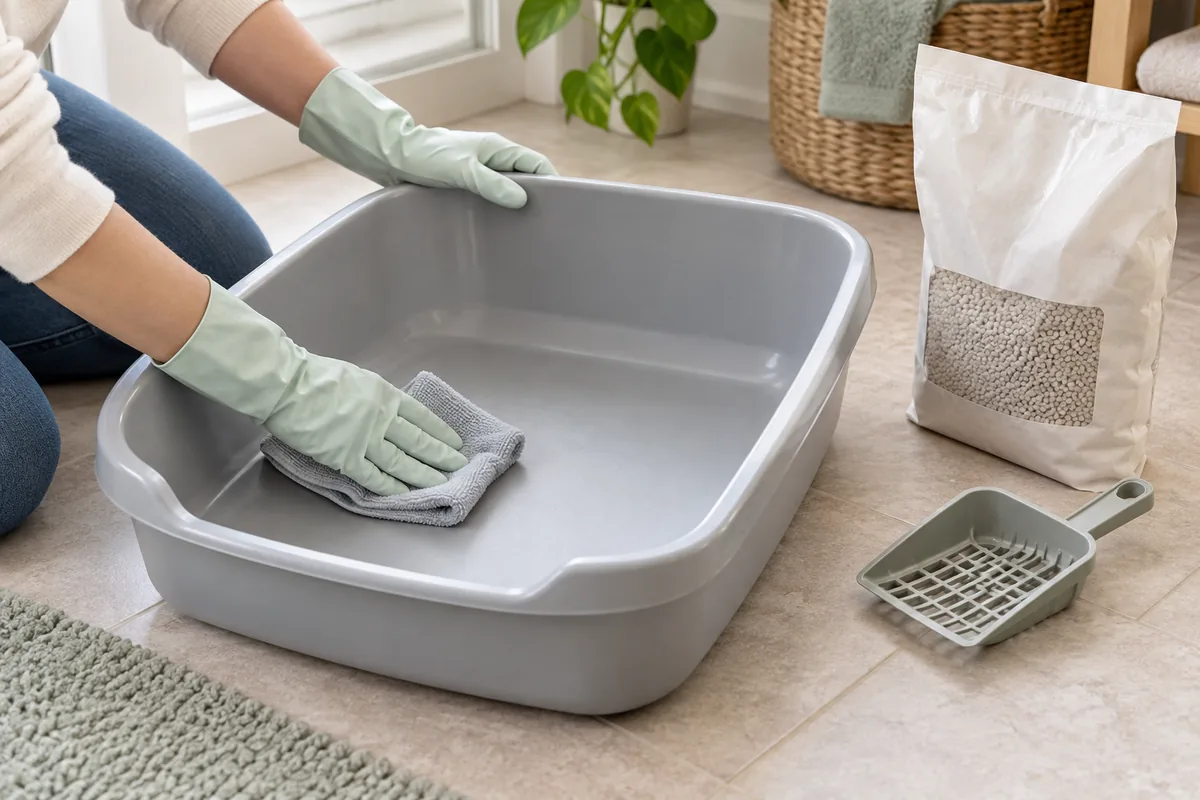
You scoop urine clumps and stool out of your cat’s litter box every day, but do you still need to throw away all the remaining litter? When deciding how often to change cat litter, separate daily waste removal from a complete litter change. Remove waste at least once a day. Adding fresh litter cannot replace changing all the litter and washing the box. [1] [2]
One source recommends replacing non-clumping litter every week, while a 2–3-week interval for clumping litter is a reference point only when it is scooped thoroughly every day. These are not guaranteed lifespans for every product. Consider the litter type, product instructions, and how much the box is used. If odor or soiling remains, clean it before the scheduled date. Here is how to plan a complete change and work through the washing steps. [1] [2]
Three key points
01
Remove waste every day
Check and scoop daily, regardless of when the next full change is due.
02
Topping up is a separate task
Restoring the litter level is different from replacing all the litter.
03
Check the condition, not just the date
If the box is dirty, clean it even if the recommended interval has not passed.
Scooping, topping up, and complete changes are different tasks
“I changed the litter yesterday” can mean different things in different homes. Did you scoop out urine clumps, add fresh litter, or empty and wash the box? Separating these jobs makes a care schedule easier to plan.
- Waste removal: the daily scoop
- Remove stool, urine clumps that can be scooped out, and any visible soiling. A recent complete litter change is not a reason to skip today’s waste removal.
- Topping up: replacing the litter removed during cleaning
- Add litter to make up for what you have removed. Check the amount recommended on the package and how your cat uses the box. Pouring in more litter does not remove the need to clean it.
- A complete change and wash: caring for both litter and box
- A complete change means emptying out all the remaining litter. Washing means cleaning the soiling from the empty container. This article suggests planning these tasks together so that replacing the litter does not leave residue on the bottom of the box overlooked.
These task definitions draw on sources that discuss daily care, topping up, and washing separately. [1] [2]
How often should you change cat litter?
First, check the package to see whether the litter is clumping or non-clumping, and what it says about replacement and washing. The intervals below are reference points to compare when planning care. They do not guarantee that the litter will remain usable until that date.
| Care task | Reference interval and conditions |
|---|---|
| Remove waste | At least once a day. Some guidance recommends at least twice a day. Check more often if the box gets heavy use or your cat avoids it when soiled. [1] [3] |
| Replace non-clumping litter | Cat Friendly Homes recommends a complete change every week. Do it sooner if the litter is heavily soiled or the product specifies a shorter interval. [1] |
| Replace clumping litter | Humane Colorado suggests 2–3 weeks provided the litter is scooped daily. Replace it sooner if odor remains or the litter is very wet and clumped together. [2] |
| Wash the empty box | Cat Friendly Homes gives a 1–4-week washing interval, while Cats Protection recommends a full clean at least weekly. Plan litter changes and washing together, and do not wait for the scheduled date if the box is dirty. [1] [3] |
Why do the organizations give different intervals? The guidance reviewed for this article does differ. These numbers alone cannot establish one schedule for every product and household. Start with the product instructions and check the condition daily. If you do not yet know how well cleanliness is maintained, this article’s practical suggestion is to begin with more frequent checks and cleaning rather than the longest interval.
For example, even if a complete change is scheduled for next weekend, do it today if odor and large areas of wet litter remain after scooping. Equally, avoid repeatedly postponing a planned wash just because you cannot smell an odor.
Do bentonite and tofu litter need different replacement schedules?
The sources reviewed did not provide evidence for fixed intervals based on material alone, such as “bentonite always lasts a month” or “tofu litter always needs replacing after a week.” Even with the same material, check the product instructions and the actual level of soiling together.
Bentonite: check the clumping label and how well clumps are removed
If the product is labeled clumping, use the clumping guidance in the table alongside its instructions. Look for small pieces left behind when clumps break during scooping, or soiling stuck to the bottom that you may have missed. This is a way to check how thoroughly you are cleaning at home, not a test that ranks products.
Tofu and mixed litter: check the product’s care instructions
For tofu litter, first read about its clumping properties, recommended amount, and complete replacement instructions. If it contains a mixture of materials, do not carry over your previous product’s schedule simply because the label says “tofu.” The same principle applies: adjust the schedule to the condition of the litter left in the box.
Checking the cleaning schedule for litter your cat already uses comfortably is also different from switching to a new material, scent, or brand. If you change the product and location while testing a cleaning interval, it becomes harder to identify what caused any change in litter box habits. Changing fewer things at once is an editorial suggestion to make observation easier.
How to change all the litter and wash the litter box
Before a complete change, gather fresh litter, a disposal bag, and cleaning tools reserved for the job. Keep your cat away from cleaning products and the wet box while you work. Having another usable litter box available can make the process easier.
- Empty out all the remaining litter.
Dispose of litter and waste according to the product’s disposal instructions and the requirements where you live. Remove residue from the bottom and corners before washing. - Wash according to the box’s care instructions.
For a washable box, remove soiling with suitable soap or detergent and water. Check the container’s care instructions first for suitable cleaning products and water temperature. Avoid strongly scented products and those containing ammonia. [1] [4] - Treat disinfection as a separate step.
Washing away soiling and using a disinfectant to reduce pathogens are different tasks. The CDC recommends regular disinfection of items that come into contact with pet waste. Choose products and methods according to the box’s instructions, the disinfectant label, and veterinary guidance. Do not improvise dilution strengths. [4] - Rinse thoroughly and let the box dry completely.
Rinse away soap and residue, then dry the box before use. If you used a disinfectant, also follow its label for contact time and whether rinsing is required. Keep your cat from licking or touching wet cleaning or disinfecting products. [4] - Add fresh litter and watch how your cat uses it.
Fill to the amount recommended by the product, then check whether your cat uses the box as usual. Fresh litter does not necessarily mean your cat will accept an unfamiliar scent or texture. - Record the date and anything unusual.
Note the date of the complete change and wash, plus the condition before cleaning. This helps you track how many days passed before odor remained without relying on memory alone.
For an automatic litter box, do not apply this sequence to the entire machine. Electrical parts and washable parts may require different handling. Follow your model’s manual for what can be disassembled and washed with water.
If litter odor remains after cleaning
Before repeatedly adding fresh litter to deal with odor, check the following in order. This checklist helps you find overlooked soiling; it does not diagnose the cause of an odor.
- Remaining litter: Look for small pieces of waste or wet patches left behind. If it is heavily soiled, replace all the litter instead of just topping it up.
- Box and scoop: Check the corners, bottom, and scoop for stuck-on residue. With a covered box, remember the inside of the cover.
- Surrounding area and waste bag: Check whether waste has soiled the mat or floor, or whether the odor comes from the bag holding the waste you removed.
- How much the box is used: See whether one box gets more use than the others. Boxes cleaned on the same day can become soiled at different rates.
Masking odors with strongly scented litter or air fresheners can make a cat reluctant to use the box. Prioritize an environment your cat uses comfortably over a fragrance that appeals to people. This check sequence draws on guidance to replace litter when odor and soiling remain and to avoid strongly scented products. [2] [3]
Keep a simple record to find a suitable litter change schedule
You do not need a complicated chart. Keep four things in a phone note: the complete change date, product used, condition after daily scooping, and next planned change. In a home with multiple cats, separate notes for each box make it easier to compare which ones need more frequent care.
A simple note to copy
- Box name / litter product and type:
- Last complete change and wash:
- After today’s scoop: odor / wet residue / soiling on the bottom
- Next planned date, based on the product instructions:
- Reason for cleaning earlier than planned, if applicable:
If the box repeatedly becomes dirty before the planned date, bring the next date forward. Avoid automatic calculations such as halving the interval simply because you have two cats. These notes help you adjust to actual use and product condition; they do not calculate a maximum safe lifespan.
This record is petggom’s suggestion for easier day-to-day care. It is not a validated health assessment or a method guaranteed to prevent disease.
Signs that veterinary care comes before litter box cleaning
If your cat suddenly urinates outside the box or changes its litter box habits, do not assume dirty litter is the only reason. Health problems also need to be considered, and scolding your cat for an accident will not help. [3]
If you see blood in the urine or your cat appears to be in pain while urinating, contact a veterinary clinic for advice on when to be seen. Odor or litter clumps alone cannot diagnose a disease. Share the behavior you observed and when it happened. [5]
Complete litter changes: frequently asked questions
Q. If I scoop urine clumps every day, can I skip complete changes?
No. Daily scooping is a partial clean. You still need a separate schedule to care for the remaining litter and the box. Adding small amounts of fresh litter does not complete the whole care routine.
Q. Can I use clumping litter for a full three weeks?
Three weeks is not a guaranteed lifespan. Consider the product instructions and the condition after each daily scoop, rather than relying on a number alone. Replace the litter early if odor or soiling remains, even if the planned date has not arrived.
Q. Will switching to tofu litter solve odor and replacement problems?
Changing the material alone cannot guarantee a solution. First check remaining soiling, cleanliness of the box and surrounding area, and how much it is used. Read the new product’s instructions and separately check whether your cat uses it comfortably.
Q. Do I need a strong disinfectant every time I wash the box?
Stronger is not necessarily better. Distinguish cleaning from disinfecting. When disinfection is needed, follow the label of a suitable product and veterinary guidance. Do not mix cleaning products or let your cat come into contact with the chemicals. [4]
Q. Can I change the litter in all the boxes on the same day?
You can choose a convenient date, but check each box to see whether it stays clean until then. We suggest cleaning them in sequence so your cat is not left without a usable box while they are all being emptied.
Using litter economically does not mean delaying cleaning. Remove waste daily, plan complete changes using the product instructions, and bring the date forward when soiling calls for it. Start today by noting when you last emptied all the litter and washed the box.
References
- Cat Friendly Homes: Everything You Should Know About Litter Boxes
FelineVMA guidance for cat owners on waste removal, complete changes of non-clumping litter, and box washing intervals. - Humane Colorado: Litter box tips for new cat owners
A conditional interval for replacing clumping litter, adjustments for odor and soiling, and why topping up cannot replace cleaning. - Cats Protection: Cats & Toileting
Recommendations for twice-daily waste removal and weekly full cleaning, plus guidance on strong scents and sudden changes in toileting. - CDC: About Cleaning and Disinfecting Pet Supplies
Cleaning versus disinfecting supplies, rinsing and drying, and safe product use. This source does not set a replacement interval for a particular litter. - Cornell Feline Health Center: Feline Lower Urinary Tract Disease
Signs of urinary problems and the need for immediate veterinary attention when urethral obstruction is suspected.
Sources checked:
This article provides general day-to-day care information. It does not replace an individual product’s instructions or veterinary diagnosis and treatment. If your cat has a health condition or needs special care, discuss an appropriate routine with your veterinarian.